
Natural blue food coloring: Making sense of today’s options
Natural blue food coloring is entering a new phase. Recent Food and Drug Administration (FDA) approvals in the United States have expanded the range of available options, while also raising new questions about performance, formulation, and commercial feasibility. For developers, the challenge is no longer whether natural blue exists, but how to navigate a growing set of choices with very different characteristics. This article offers a grounded perspective on today’s natural blue landscape in the U.S., what has changed, what remains complex, and how to approach natural blue with a long-term view.
Key takeaways
- Replacing synthetic blue shades with natural alternatives remains one of the most technically complex challenges in color formulation.
- Recent FDA approvals have expanded the natural blue toolbox in the U.S., but suitability and performance still depend on the specific product and process.
- Natural blue options differ fundamentally in chemistry, stability, supply chain, and visual hue.
- Spirulina extract remains the most established natural blue globally, though it requires careful handling in formulation and processing.
- Long-term success with natural blue depends on reliable supply, consistent quality, and the ability to scale, not on hue and performance alone.
Why blue is different
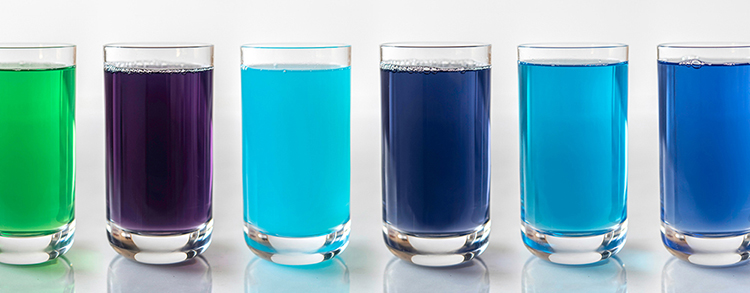
Interest in natural blue alternatives has increased significantly as the food industry accelerates its move away from synthetic color additives such as FD&C Blue No. 1, Blue No. 2, and Green No. 3. While many red, orange, and yellow shades can be achieved using familiar plant sources such as fruits, vegetables, and spices, blue presents a fundamentally different challenge.
Suitable blue color compounds are rarely found in nature. Commonly used fruit and vegetables such as black carrots contain anthocyanin pigments that will appear blue at high pH levels, but their shades become unstable in these conditions. As a result, achieving effective natural blue solutions in food and drink depends on identifying alternative sources from nature and navigating the regulatory pathways required to enable their use as food color additives in the U.S.
This reality has shaped the evolution of natural blue differently from other color categories. Rather than relying primarily on juice-based pigments, the natural blue toolbox has developed through a mix of plant- and algae-based sources, as well as reaction-based color systems, each with distinct chemistry, performance characteristics, and commercial considerations. As regulatory approvals have expanded, so too has the need for clearer guidance on what these options actually mean in practice.
A changing regulatory landscape in the U.S.
In 2025, the FDA formally listed several new plant-derived blue color additives, expanding the options available to food and beverage developers. These actions represent meaningful progress for a category that has historically had limited alternatives.
This discussion focuses primarily on the regulatory status of natural blue color additives in the U.S. Regulatory acceptance varies globally, and many of the newer alternative blue solutions referenced here are under review or approved with restrictions in other regions, including Europe, and may not yet be permitted in all global markets.
It is important to distinguish regulatory approval from functional performance. FDA approval establishes what is permitted under defined conditions of use and does not guarantee that a color will perform consistently across different formulations, processes, or shelf-life requirements. Each approved blue is tied to specific food categories, labeling requirements, and good manufacturing practice, and each behaves differently once introduced into a real product.
Spirulina extract illustrates this distinction well. While it has been used globally for decades, expanding its permitted uses in the U.S. has required sustained regulatory engagement. In late 2022, the FDA expanded permitted uses of spirulina extract to include beverage applications, including alcoholic beverages up to 20 percent alcohol by volume. This regulatory milestone helped open the door to broader use of spirulina-based blue in ready-to-drink beverage systems, while also highlighting the importance of formulation and processing considerations in achieving stable color performance.
The natural blue toolbox: what’s available today
The overview below describes the current landscape of FDA-approved natural blue color options in the U.S. market. Not all of the color sources discussed are commercially offered by GNT, and availability, readiness, and regulatory status vary by supplier and/or region.
Genipin-derived blues: gardenia and jagua
Gardenia (genipin) blue and jagua (genipin-glycine) blue are often described as genipin-derived colors. In their natural state, both gardenia blue (Gardenia jasminoides) and jagua or huito fruit (Genipa americana) are essentially colorless. Unlike other plant-based blues, these colors are created through a controlled reaction process and do not originate from a naturally occurring blue pigment within the plant.
Visually, these colors tend to produce darker, navy-leaning shades. Jagua typically appears more navy, while gardenia blue often presents as slightly more gray-blue. Because the color is formed through a polymerization process, both generally show strong stability across heat, light, and pH, making them well suited for demanding applications such as high-boiled candy and other high-temperature processes.
However, while these sources may support sustainable harvesting models, they rely on plant-based raw materials sourced through seasonal agricultural systems, which can introduce constraints around scalability and consistent supply for high-volume applications.
Naturally occurring blue sources: spirulina, galdieria, and butterfly pea
Other natural blue options are derived from naturally occurring color compounds present in the source material, using water-based extraction and physical processing.
Spirulina extract and galdieria extract both derive their blue color from phycocyanin. Spirulina is harvested year-round from ponds using automated systems, primarily in Asia. Galdieria, by contrast, is cultivated through controlled biofermentation in bioreactors, producing a naturally occurring blue color compound that is then extracted using water-based processing. This production model differs from open-pond cultivation and reflects a different approach to managing production and traceability across regions.
Both spirulina and galdieria deliver sky to royal blue hues, closely aligned with the brightness traditionally associated with FD&C Blue No. 1. Galdieria is often noted for improved acid stability relative to spirulina, though both remain sensitive to high heat due to the protein-based nature of phycocyanin.
Butterfly pea flower extract, derived from Clitoria ternatea, is an anthocyanin-based color. It appears blue in formulations with a pH typically around 4–6, but shifts toward violet in more acidic systems. While butterfly pea is naturally heat- and light-stable and offers a distinctive visual effect, its reliance on hand-harvested flowers and limited scalability has constrained supply restricting its use largely to niche or premium applications.
Table 1. U.S. overview of natural blue color options
In addition to differences in sourcing and performance, natural blue options also vary in how they are produced and how they are defined under U.S. regulations. The table below summarizes these distinctions at a high level and links directly to the relevant CFR references.
| Natural blue source | How the color is produced | How it is typically declared in the U.S.* | CFR reference* |
| Spirulina extract | Cultivated algae; water-based extraction and physical processing of naturally occurring color compounds | Spirulina extract for color | 21 CFR §73.530 |
| Galdieria extract | Cultivated microalgae via controlled biofermentation; water-based extraction of naturally occurring color compounds | Galdieria extract blue for color | 21 CFR §73.167 |
| Butterfly pea flower extract | Botanical source; water-based extraction of naturally occurring color compounds | Butterfly pea flower extract for color | 21 CFR §73.69 |
| Gardenia blue (genipin-derived) | Color formed through chemical reaction of genipin with amino acids | Gardenia (genipin) blue for color | 21 CFR §73.168 |
| Jagua blue (genipin-glycine) | Color formed through chemical reaction of genipin with amino acids | Jagua (genipin-glycine) blue for color | 21 CFR §73.225 |
*CFR references and declaration language should always be confirmed through regulatory review.
Figure 1. Visual comparison of blue color options in a pasteurized ready-to-drink beverage (pH 2.9)
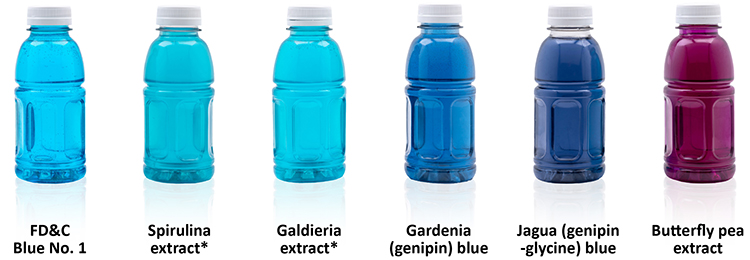
*Note: Samples shown were formulated with a hydrocolloid-based stabilization system to support color performance under acidic, pasteurized beverage conditions.
Key considerations when evaluating natural blues
Selecting a suitable natural blue depends on how the color will perform within a specific product and process. Key considerations include the required visual tone for the target shade and how the color will be exposed to heat, acid, light, or oxygen during processing and shelf life. Labeling requirements and long-term supply reliability also play an important role in determining suitability.
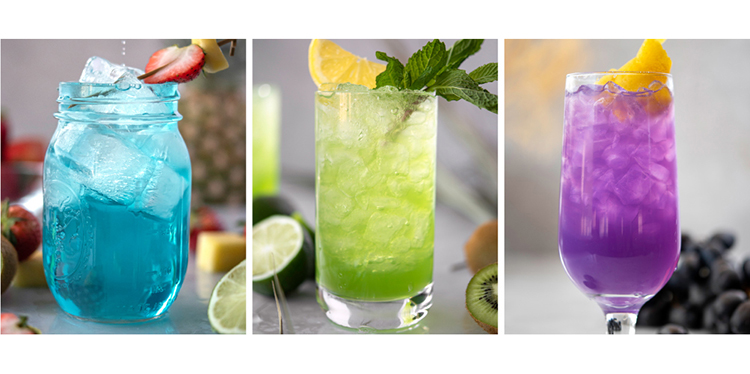
The underlying blue tone and how it blends with other colors are especially important when blues are used to create secondary shades such as green or violet. Sky-to-royal blue hues, such as those delivered by spirulina extract and galdieria extract, blend more cleanly with yellow colorants to produce brighter, more natural-looking greens. By contrast, darker navy- or gray-leaning blues may be well suited to achieving deep blue or violet shades, but they can limit the achievable range of green hues. Because green remains widely used across beverages and other applications, the blue tone often influences color selection alongside stability and processing performance.
For global product development, early alignment on target markets and regional regulatory requirements remains essential alongside formulation and performance considerations.
Spirulina in context: Leadership, learnings, and limits
Among today’s natural blue options, spirulina extract has the broadest regulatory acceptance globally, with approvals across the Americas, Europe, and large parts of Asia.
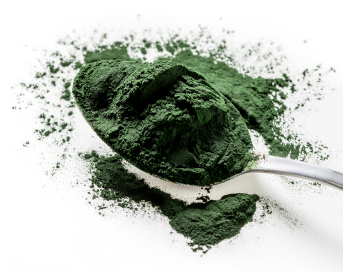
It is also suitable for use in a vast range of applications, although it does not perform uniformly across formulations. Its blue color compound, phycocyanin, is a protein-based structure that is inherently sensitive to heat and acid. Successful use therefore depends on understanding how the color behaves within the full recipe and process, including order of addition, mixing conditions, and overall process design.
Today, advances in formulation techniques have ensured spirulina extract has become a foundational reference point in many natural color strategies, with its bright sky-to-royal blue hue making it one of the closest natural alternatives to FD&C Blue No. 1.
At GNT, supporting the commercial use of spirulina as a food color has involved a combination of sustained regulatory engagement with hands-on formulation and scale-up experience. This has included petitioning the FDA to expand permitted food and beverage categories, working closely with customers to translate approvals into viable applications, and investing in dedicated, large-scale spirulina production infrastructure. GNT operates a dedicated spirulina extraction facility in Europe, providing an alternative supply footprint for manufacturers focused on long-term reliability.
Practical considerations going forward
Despite recent regulatory progress, meaningful limitations remain for natural blues. Replacing synthetic blues in high-heat or long shelf-life applications continues to present challenges, and trade-offs between hue, stability, cost, and supply reliability are unavoidable. No single natural blue solution meets all requirements across all applications.
Manufacturers must also consider how newer natural blue ingredients are perceived by consumers. Many emerging blue sources are not yet as familiar as common fruits, vegetables, or spices, and ingredient recognition can influence labeling decisions and brand communication. This challenge is not unique to newer blues. When spirulina extract was first introduced as a food color in the U.S., consumer familiarity was limited. Over time, broader recognition of spirulina as a protein-rich, functional ingredient helped build awareness and acceptance.
Looking ahead, progress in natural blues is likely to continue through incremental expansion rather than a single breakthrough. Success will depend on aligning regulatory scope, formulation needs, supply capability, and consumer expectations early in the development process.
At GNT, our role is to support that alignment by sharing experience, translating complexity, and partnering with customers as natural blue solutions continue to evolve.