
Natural green color in baked goods: Current insights on the U.S. spirulina review
On February 6, 2026, the U.S. Food and Drug Administration (FDA) issued a final order that would expand the permitted uses of spirulina extract as a color additive in human foods generally. However, as of March 24, 2026, the effective date of that order has been delayed indefinitely following the filing of formal objections. The FDA has stated that this delay is a procedural step and does not reflect a change in its safety assessment, but the expanded uses are not currently in effect. This article focuses on opportunities for achieving natural green shades in baked goods and key formulation considerations that influence performance in bakery systems.
Exploring possibilities for natural green in baked goods
For many concepts, natural green is about subtle flavor signaling. A light green crumb in a layered key lime cake can reinforce citrus notes and create visual differentiation without overpowering the product’s natural appearance.
Green also supports more indulgent or premium concepts. Pistachio cheesecakes, matcha-inspired pound cakes, and layered desserts benefit from a soft to moderate green tone that communicates flavor before the first bite.
Beyond subtle greens, deeper and more expressive tones are also possible. Higher-intensity spirulina formats can support more saturated greens and blue-forward bakery concepts, expanding the visual range available to developers.
From citrus and pistachio to seasonal, celebratory, or limited-time themes, natural green and blue shades can now be explored more freely within baked systems for the U.S. market.
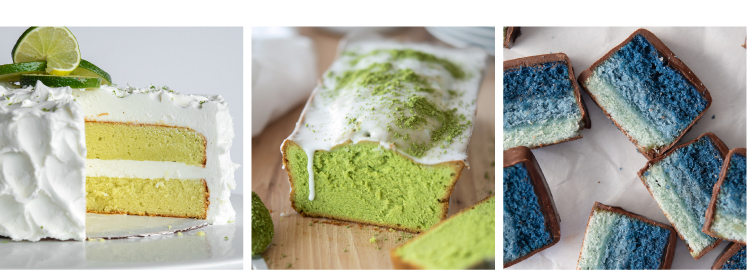
Examples of natural green and blue shades incorporated directly into baked applications, from layered key lime cake, match-inspired pound cake, and ombre spirulina-colored cookies.
Developing natural green in baked systems requires balancing shade intensity, format, and baking conditions.
The following principles help guide formulation.
1. Account for oven heat
Spirulina extract is sensitive to extended heat exposure. During baking, some reduction in blue intensity can occur.
To achieve the desired crumb shade, batters and doughs are typically formulated with slightly higher intensity than the final color target, ensuring the baked result aligns with the intended green tone.
2. Balance blue and yellow after baking — not before
Natural green is created by blending spirulina extract with a yellow component.
While spirulina may soften during baking, many yellow color sources — including turmeric- and carotene-based options — are highly heat stable and can maintain or even brighten in tone.
As a result, pre-bake batters may be formulated with a slightly more blue-leaning shade to achieve the correct green balance after oven exposure. This post-bake hue adjustment is a critical part of successful green development in bakery systems.
3. Select the right color format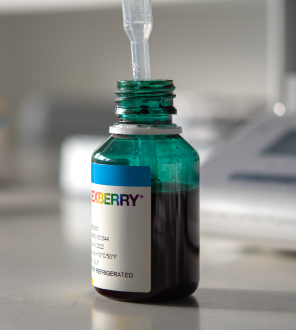
Format plays an important role in performance, handling, and cost-in-use:
- Liquid colors may be well suited for incorporation through high-water ingredients.
- Powder formats can integrate efficiently into dry blends, cake mixes, or fat/sugar creaming phases.
- For applications targeting stronger green or blue tones, concentrated spirulina powder formats can help deliver higher color intensity while managing overall inclusion levels.
- In fat-containing systems such as cookies and cakes, oil-soluble carotene formats may support efficient dispersion, while water-dispersible options remain suitable depending on formulation preferences.
Selecting the appropriate format supports uniform distribution, shade consistency, and practical formulation outcomes.
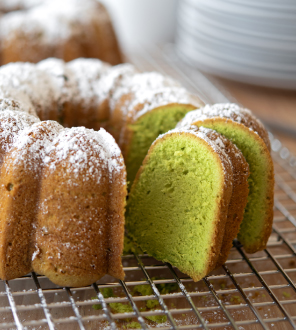
4. Expect surface browning
During the heating stage, caramelization and Maillard reactions naturally create a browned exterior in baked goods. This is expected and should not be interpreted as color instability.
Designing around this visual contrast — brown exterior, green interior — is part of developing realistic and appealing natural bakery concepts. Natural green tones are most visible within the crumb once sliced.
.
A broader opportunity for natural green innovation in bakery
Recent regulatory activity in the U.S. has brought renewed attention to how spirulina‑based blue components behave in baked systems and how developers can approach natural green and blue tones within their existing formulation frameworks. While the effective date of FDA’s February 6, 2026 final order has been delayed, interest in natural green bakery concepts continues to grow.
Successful development still depends on thoughtful formulation, appropriate format selection, and alignment between target shade and bake profile. Understanding how blue and yellow components shift during heating remains central to achieving consistent results.
With the right approach, brands can now deliver green and blue shades within batters and dough systems, opening new paths for product innovation.
With the right approach, brands can develop green and blue shades within batters and dough systems to support flavor storytelling, seasonal concepts, and differentiated visual experiences in bakery applications.
Natural green in baked goods continues to be a strong area of exploration for developers, offering both creative and technical possibilities across a wide range of bakery formats.
Explore natural color solutions for bakery
If you are developing baked goods and evaluating natural color solutions, our team can support you with:
- Application-specific formulation guidance
- Shade optimization based on your bake conditions
- A range of color formats, including high-intensity spirulina options for strong hues